

WELCOME
Good morning First Baptist. We welcome you to worship this morning. Be sure to remember your brothers and sisters in Christ throughout the week as you pray for them, and as the Holy Spirit brings their faces to your mind. Be sure to also connect with them in the ways that are possible. And if you have any questions or would like to talk to someone, please don’t hesitate to contact the church through the church telephone and leave a message. (519-733-4144)
Call to Worship
We gather in the name of the Holy One, Rock of Life,
Ever Loving God, Strength and Power,
Love and Gentleness.
Come into the fold.
Join the journey,
and we are blessed to be able to gather in His presence!
Welcome to Worship!
Songs
Prayer
CONFESSION
God of mercy and patience, be with us this day as we celebrate One Great Hour of Sharing. Help us to remember that the gifts we give, go to help many people in need. Remind us again that our lives are meant to be gifts to others, for healing, hope, comfort, peace and love. Forgive us when we get so caught up in the details of living and when we become so overwhelmed by the world’s demands of us that we neglect to help others.
Enlighten us again with Your spirit and Your words of healing love. Caring and sharing are the hallmarks of discipleship with Jesus Christ.
Heal and forgive us.
Give us hearts for joyful caring and sharing; for it is in Jesus’ name, we offer this prayer. AMEN.
ASSURANCE OF PARDON
Let God’s love and mercy wash over you, that same love and mercy is what brings us the promise of new life and hope. Be assured of that. AMEN.
Today's Message
For the past several weeks, one of the themes that has been very prominent throughout our discussion of the Emotionally Healthy Discipleship Book has been the counter cultural nature of true Discipleship. In other words, becoming more and more emotionally healthy, in a spiritual sense, is going to increasingly look different than the world around us – or at least how the world around us tells us we should look. This week and next week will be our last weeks in the book, and in this series – these two messages will fit together in a summary sense. As you can see from the title this morning, we are going to talk about the Theology of Weakness. Now we should spend just a brief moment on that because in a way you might be thinking, isn’t that a bit of a paradox – and in a manner of speaking, you’d be right. You see the word Theology in the Christian context means the study of the nature of God and so you might think well how a study of God might, who we believe to be sovereign and mighty – omnipotent, all powerful – how does that and weakness fit together. Well in this the last chapter of Scazzero’s book that’s exactly what he reveals as a very necessary component of true discipleship…
When I was in my late teenage years and even well into my early 20’s and I was a student, I was, believe it or not, in pretty good shape. I played football and baseball, worked on the farm and I went to the gym regularly. I truly was in good shape.
Now that I’m older, I’m realizing that I’m not what I used to be—by a long shot. My get up and go has done got up and went. Truth be told, some days I plan my outside chores in shifts. Sometimes I have to come up for air more than once just to tie my shoes. Honestly, I’m weak compared to what I used to be.
Facing our weaknesses, though, isn’t limited only to the physical. We can struggle spiritually too. We can feel weak when it comes to maintaining good relationships with each other, and a good relationship with God as well. We become weak as we struggle with temptation, or any type of difficulty in our life. We may want to do the right thing, but we can’t stand on our own, because we weren’t meant to stand on our own.
Thankfully, God tells us, and I want you to see today is that He will sustain us. In fact, God is the only One who can sustain us.
The Bible regards David as the model king of Israel, and the books of Samuel, Kings, and Chronicles describe his many successes. Yet even David, “a man after God’s own heart” (1 Samuel 13:14), abuses his power and acts faithlessly at times. If you study the life of David we see that he tends to succeed when he does not take himself too seriously, but gets into serious trouble when power goes to his head—for example when he takes a census in violation of God’s command.
Scripture Reading: 2 Samuel 24:10-17
10 David was conscience-stricken after he had counted the fighting men, and he said to the Lord, “I have sinned greatly in what I have done. Now, Lord, I beg you, take away the guilt of your servant. I have done a very foolish thing.”
11 Before David got up the next morning, the word of the Lord had come to Gad the prophet, David’s seer: 12 “Go and tell David, ‘This is what the Lord says: I am giving you three options. Choose one of them for me to carry out against you.’”
13 So Gad went to David and said to him, “Shall there come on you three years of famine in your land? Or three months of fleeing from your enemies while they pursue you? Or three days of plague in your land? Now then, think it over and decide how I should answer the one who sent me.”
14 David said to Gad, “I am in deep distress. Let us fall into the hands of the Lord, for his mercy is great; but do not let me fall into human hands.”
15 So the Lord sent a plague on Israel from that morning until the end of the time designated, and seventy thousand of the people from Dan to Beersheba died. 16 When the angel stretched out his hand to destroy Jerusalem, the Lord relented concerning the disaster and said to the angel who was afflicting the people, “Enough! Withdraw your hand.” The angel of the Lord was then at the threshing floor of Araunah the Jebusite.
17 When David saw the angel who was striking down the people, he said to the Lord, “I have sinned; I, the shepherd, have done wrong. These are but sheep. What have they done? Let your hand fall on me and my family.”
Wow, those are tough words to read, aren’t they? David certainly knew spiritual weakness and it cost him and his people greatly. Yet despite David’s failings, God fulfills His covenant with David and treats him and the nation of Israel with mercy, even though David had to try it his way – on more than one occasion.
I want to share three key points with you this morning that help underscore the examples of David’s weakness and how they apply to our own journey where weakness is concerned. And the first point is this:
- Western Culture, including the church, places a high value on power and influence.
Now we’ve talked a lot about this before – success, greatness, popularity, these are all values that the world around us says should be first and foremost in our lives. The problem is, as we’ve discussed this, is that when these are the values we live by, then outcomes like pride and defensiveness become the fruits of our existence and in a follower of Jesus, that is simply a glaring contradiction. Think about it: God came to earth, not in a flashy show of signs and wonders, but as an infant born into poverty and obscurity. After living as a refugee in Egypt, Jesus returns to grow up in Nazareth, a backwoods town a long way from the big city of Jerusalem. He waited thirty years to begin any public ministry, and even then, refused to do miracles on demand or to overwhelm people with His knowledge. At the time, Jesus’ ministry was small and almost invisible by the world’s standards – even the world then. Throughout His ministry, Jesus exercised His power carefully so as not to manipulate or force people into following Him. He revealed just enough of Himself to make faith possible but hid just enough of Himself to make faith necessary. For example, recall His triumphal entry into Jerusalem, He rode not on a magnificent war horse like a Roman Emperor, but a humble donkey. And in His greatest act of strength…and weakness, He allowed Himself to be arrested and treated as if he were a common criminal. At the outset, through Jesus, God chose to come to us in weakness. But that’s not all.
- I believe very much that this is part of God’s design.
Again, think about this: God built brokenness and weakness in the fabric of all life when He allowed the consequences of the fall (Genesis 3:16-19). Remember last week Pastor Marlee contrasted for us the two states of creation – the perfection at the beginning and then the consequences of the fall. And I use the word consequences because it’s obvious that God decided that those consequences should reveal themselves in our weaknesses so that in our weakness, we would have no choice but to seek Him and recognize our need for Him as a Saviour. Think about your own situation today. I can’t tell you how many times in the 13 weeks we’ve been here that Marlee and I have heard many of you say one of two things. I’m tired or I’m lonely. Tired, exhausted, overwhelmed. Our world has been operating on an adrenaline high for the past two years, necessary for survival I get that, but what I also get is that as the pandemic becomes endemic and there’s no need for the adrenaline of survival, a lot of us are going to collapse in exhaustion, we will get up close and personal with our weakness there. That sounds ominous, doesn’t it? I know it does because the world treats weakness and failure as a liability, but let me assure you that God sees our weakness and vulnerability as a gift – yes, a gift because it can become the source of our greatest strength in Him.
- You see over and over again; God invites us to a posture of constant brokenness and vulnerability – one in which we lean into Him in order to be lavishly overwhelmed by His love.
But practicing vulnerability daily as a lifestyle is difficult—I too, know this only too well. One of the best illustrations of this principle is captured in the parable of the prodigal son from Luke 15:11–32. If you come downstairs into our study, you’ll see this painting on our wall.
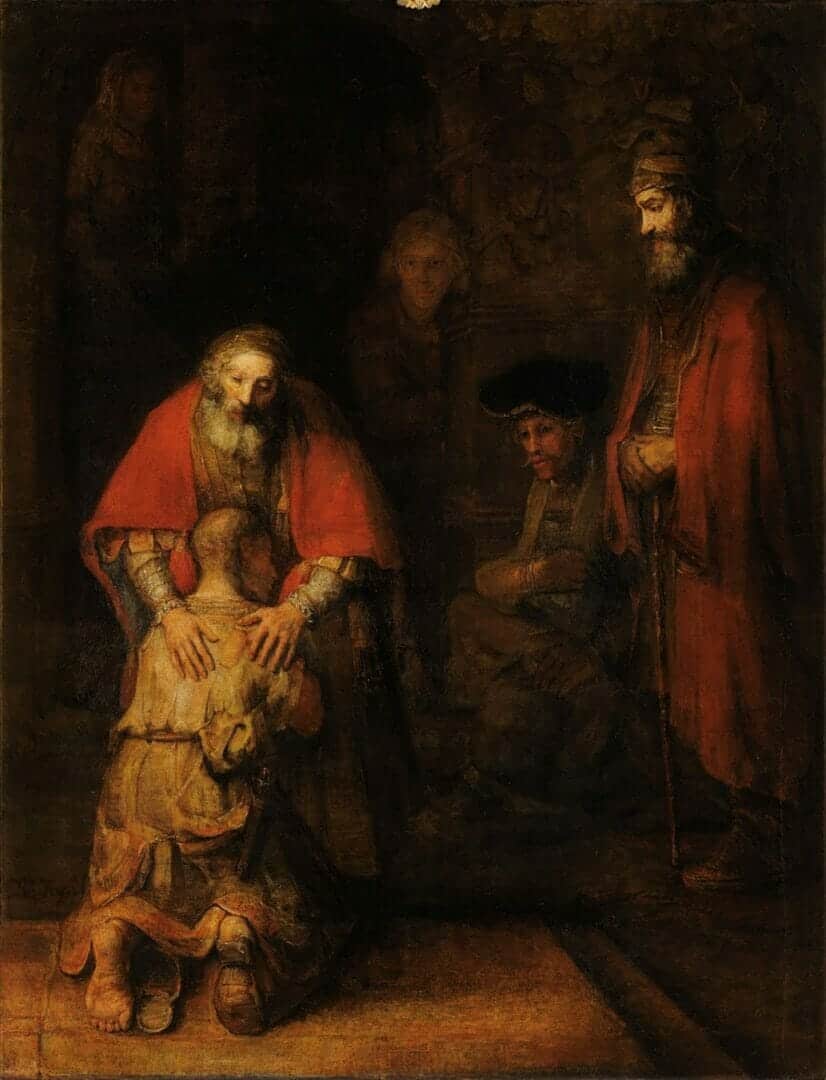
I have for a long time been particularly drawn to how Rembrandt captured the reunion scene in his painting, it’s called The Return of the Prodigal Son. I think for us this morning it provides a beautiful visual aid to help us choose the pathway of brokenness, weakness, humility, and vulnerability.
Let me point some things out to you here. Note how the younger son is bald, seemingly exhausted from his journey and emaciated – remember he had to eat as the pigs ate, no cloak, wearing only one tattered shoe, an absolute mess. He is a picture of a life that has been broken. But in the parable, the father runs – greek trécho – to him and then kisses him repeatedly. Both of these actions by the father were incredibly counter cultural. The father in that time, would be wearing a robe and a cloak and someone of his stature would never run, ever. Yet here Jesus portrays him running through the village (because they would most likely have lived in a small village setting) running through the streets for all to see and then kissing his son. The original language here would have us see the man kissing his son repeatedly with the tenderness and sincerity that Rembrandt captures in the picture here. But there’s something more important for our conversation this morning that I want you to see here.
What does it look like to stray from weakness and brokenness? The older son shows us. Look at how Rembrandt portrays him in the painting, he is well-clothed in a gold-embroidered garment like his father’s. However, unlike his father, he appears to be judging, annoyed, and disapproving of his father’s lavish reception of his youngest son, who has disgraced the family and squandered the family fortune. Although the older son has done nothing wrong, in the eyes of the world around him, what Jesus wants us to see in this parable is that his heart is far from right. He is, in fact, more lost than his younger brother because he cannot see how lost he truly is. His devotion to the world’s standards of respectability, self-righteousness, and duty have blinded him to his own condition. He is living in the father’s house, but the real truth of the matter is that he, too, has left home and remains far from the father’s love. You know, since the first time that I saw this picture years ago now, the elder brother serves as a warning to me that it is possible to obey God’s commands, serve in God’s house, and still be lost. I, like many of us, am not immune from appearing to be near God and yet actually be very far from him. When I am not intentional and purposeful about embracing my weakness and vulnerability every day, I become the older son. I know I am falling into older son territory when I hold on to my anger rather than confess and process it, or when I find myself grumbling and complaining a lot, and when I have a hard time letting go of hurts. These are all sure signs I am the lost older son.
Even though I began our message pointing out some of his more we’ll know flaws, King David knew that acknowledging imperfections was critical.
As I related earlier, the phrase most often used to describe David is that he was “a man after God’s own heart.” We observe that heart, of course, in the many psalms he wrote as well as the many victories he achieved. But one of the most vivid pictures we have of David’s heart is revealed not in a triumph but in a colossal moral failure—when he commits adultery with Bathsheba and then murders her husband, Uriah. When he is confronted by the prophet Nathan, David does not deny what he’s done, cover it up, or try to erase all memory of it from Israel’s history. Instead, he repents. And he makes sure his failure is recorded in vivid detail as a lesson for future generations (2 Samuel 12). He even writes a song about it to be sung in worship services and published in Israel’s worship manual (Psalm 51)! How many of us today would do something like that after such a colossal failure? David understood something significant about who God is and how He works. He wrote: You do not delight in sacrifice, or I would bring it; you do not take pleasure in burnt offerings. My sacrifice, O God, is a broken spirit; a broken and contrite heart you, God, will not despise. (Psalm 51:16–17) From David, we must learn the importance of speaking about our failures and struggles—not just in sermons or Bible studies, but in our own all day, everyday life. David knew that acknowledging imperfections was critical, not only for his own spiritual health, but also for the health of those he led. His life embodied God’s message that Israel’s existence as a people was based on the love and mercy of God alone and not their own performance. And if God can use a person like David, forgiving him of such a massive breach of integrity, God can use anyone—even you and me! Developing a theology of weakness is essential because the shift required to grow in our discipleship journey is to embrace weakness and vulnerability.
Let me close out the message this morning by sharing one of Scazzero’s best illustrations in which he demonstrated how God uses brokenness – Scazzero says it is the art of kintsugi. Developed in Japan in the fourteenth century, kintsugi takes broken pieces of pottery and rejoins them using a lacquer with a beautiful gold powder.12 The word “kintsugi” literally means “to join with gold.” What makes kintsugi art so unique is that it actually emphasizes the repaired breakages make the object more, not less, valuable. God has a “kintsugi” philosophy of his own—he does kintsugi on his people all the time. Each one of us has places where we are shattered, either by something done to us or wrong choices we have made. Regardless, as we offer our brokenness back to God, He carefully puts us back together in ways more spectacular and beautiful than before. Our cracks remain, but they have been sealed with gold from the Master Artist Himself. This has always been the way God works. Consider the flaws and imperfections of the heroes of Scripture:
- Peter was a loudmouth with a short fuse.
- Timothy had ulcers and struggled with fear.
- Moses was a stutterer.
- Rahab was a prostitute.
- Samson was a womanizer.
- Jonah ran from God’s will.
- Martha was a blamer.
- Noah got drunk.
God has always used “cracked-pots” to “show that this all-surpassing power is from God and not from us” (2 Corinthians 4:7).
This is the needed paradigm shift theologically.
Out of our weakness comes the beauty of restoration and flourishing in God. Choosing to make this shift in your own life is not easy, in fact, you can be sure that when you take steps to live in vulnerability and weakness, you will have to deal with multiple fears and questions, because the world around you is going to scream, why are you different, why don’t you conform? If you are like me, your mind might even gravitate to worst-case scenarios. When that happens, let me encourage you to stay the course.
And as you consider the complexity of such a transition, let me assure you that there really is a resurrection awaiting you on the other side of this journey. In fact, you can rest and relax in the truth that this is anchored in the heart of following Jesus—life comes out of death, the humble are exalted, the last are the first, and the poor in spirit do inherit the kingdom of heaven.
Prayer
O LORD, your Prophet Isaiah asks how shall we speak with you, for we are dust and ashes! And so rightly we ask that Your Holy Spirit speaks in us that we might speak to You, to draw near to You in prayer. Father, let the merits of Jesus stand for us, that we may acceptably approach You in this time. Lord God may there be a voice in our prayer for every person’s voice before you.
Lord, we have been saying to You this morning, “We are all mixed up when it comes to our priorities – we focus on the ideals of power and prestige. As the wind in this season strips the leaves from the trees and leaves them bare, so we stand before You this morning. Lord God, we wonder why You ever have any mercy on us at all; for if we were set upon the Throne, we could do nothing other than condemn ourselves, for there is not one of us that is immune from the ensnaring call of our society today. Yet, Lord, we thank You that You have saved many of us, and we rejoice in that salvation, and pray that all that hear our prayer know the gift of salvation too.
Move, Holy Spirit, over this church and all who are watching online. And Lord, look upon Your people for good. You know the troubles of every burdened spirit here. You know how some of our loved ones, family and friends are sick. You know how others are watching over those dear to them as they fade away in body or in mind. Lord send comfort to all those that carry these burdens.Bless this Your beloved church. Lord, make us an instrument of Your peace.
Where there is hatred, let us sow love.
Where there is injury, pardon.
Where there is doubt, faith.
Where there is despair, hope.
Where there is darkness, light.
Where there is sadness, joy.Lord Jesus allow that we may not so much seek to be consoled, as to console; to be understood, as to understand; to be loved, as to love.
For it is in giving that we receive.
It is in pardoning that we are pardoned,
and it is in dying that we are born to Eternal Life.Bless our country. Grant to our leaders, wisdom and strength. Holy Spirit grant that, by some means, peace may be continued, and war come to an end where it still rages; and, that the policy of truth and reconciliation – righteousness may once more be taken up across this land, and our nation be a light of righteousness for your world.
We ask all this in the name of the Father, of the Son and of the Holy Spirit.
Amen.
Song
Benediction
Go into the world with assurance, hope and promise:
that the grace of the Word of life rests upon you;
the love of the Source of life embraces you;
and the transforming power of the Breath of life
helps, strengthen and encourages you,
this day and all your days. Amen.